Resources for media and journalists.
The Global Fund, as a lean and efficient organization, does not have country offices. As a result, we needed to find another way to raise awareness and carry out advocacy efforts worldwide. An innovative solution was found: the creation of independent associations known as “Friends”, who help develop contacts and allies, promote a good understanding of the Global Fund mission, and mobilize political and financial support.
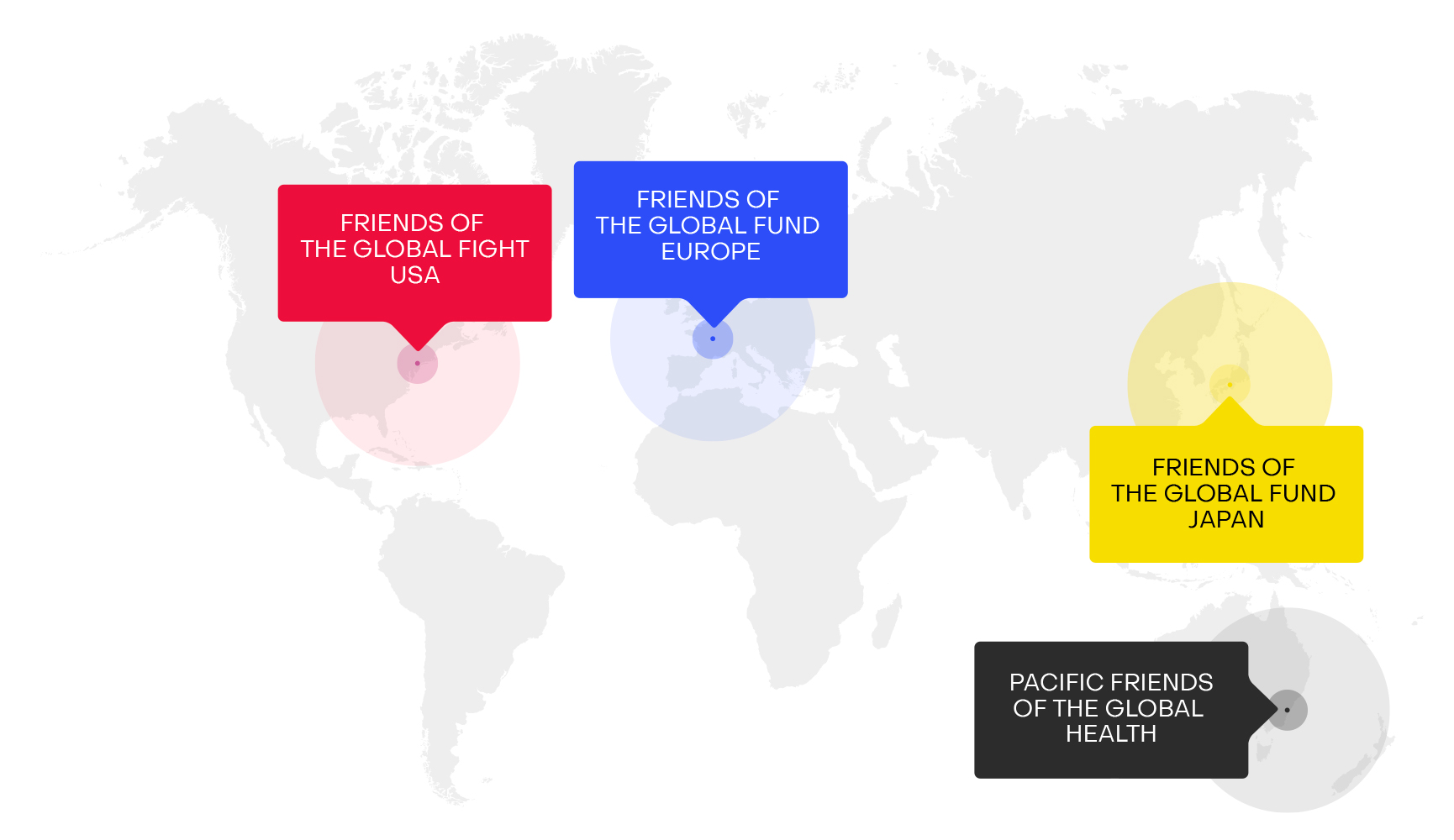
There are five active regional Friends organizations. Each one is completely independent of the Global Fund and has its own core objectives, activities and governance structure. The Friends organizations receive no financial support from the Global Fund.
Those Friends organizations working in donor countries focus primarily on mobilizing public and political support for the Global Fund, whereas Friends organizations in implementing countries tend to focus their efforts on education about the three diseases, how to access Global Fund financing for countries, and resource mobilization.

The role of Friends of the Global Fund Europe (Friends Europe) is to contribute to the fight against AIDS, tuberculosis and malaria and to promote the Global Fund in Europe by informing audiences of the Global Fund’s missions, activities, needs, results and governance. It also pursues advocacy among parliamentarians, public and private decision-makers, the media and civil society to seek partnerships and resource mobilization (in particular through budget and innovative financing mechanisms) on behalf of the Global Fund. Friends Europe is registered under France’s 1901 law governing non-profit organizations.
Friends of the Global Fund Japan (Friends Japan) is a private support group that promotes a greater understanding of the Global Fund, encourages Japan to expand its role in the battle against communicable diseases and builds cooperation between Japan and other East Asian countries in this shared struggle. Friends Japan draws upon the participation of diverse sectors of Japanese society, including the fields of government and politics, business, academia, labor, and the nonprofit sphere.
Friends Japan is administered by the Japan Center for International Exchange, which is an independent, nonprofit and nonpartisan organization dedicated to strengthening Japan’s role in international networks of dialogue and cooperation. Friends Japan also promotes regional cooperation in East Asia and cooperation between Japan and Africa.
In recent years, Friends Japan has been working to integrate Japan’s response to communicable diseases with efforts to strengthen health systems more broadly. They will continue to work closely with JCIE’s Program on Global Health and Human Security, to make sure that Japan’s efforts in both areas are integrated for mutual benefit rather than competing for resources and attention.
Friends Japan does face some challenges, however. Japan is fortunate to have relatively low levels of HIV, TB, and malaria infection within its borders. But low infection rates have led to complacency, so convincing people in Japan of the importance of fighting communicable diseases domestically and internationally has been somewhat difficult. In addition, economic stagnation and a continuing decline in overall Japanese ODA over the past several years have made securing more financial resources for the fight difficult.
Pacific Friends of the Global Fund (Pacific Friends) was established in February 2009 to raise awareness of the regional challenges posed by HIV/AIDS, tuberculosis and malaria and to build regional, political and financial support for the Global Fund. Pacific Friends is funded by the Bill & Melinda Gates Foundation and is hosted within the University of New South Wales Foundation.
The challenges to the success of the Pacific Friends project are mainly anticipated to lie in the ability of Pacific Friends to persuade the Australian and New Zealand governments and private sectors to increase their levels of support for the Global Fund, to maintain focus on achievable goals and outcomes, and to engage with leading regional policy-makers and opinion formers. The geographical size, cultural complexity and widely disparate levels of development in the region also pose substantial challenges to the mission of Pacific Friends.
Broadly speaking, the role of Friends of South and West Asia is to bring about greater awareness of the need for good health with special reference to the three communicable diseases of AIDS, tuberculosis and malaria. The main focus is on prevention. The organization seeks to publicize the activities of the Global Fund and also the socioeconomic impact of Global Fund money on these three diseases in the different countries of the region.
In addition, Friends of South and West Asia will also take on a resource mobilization role by not only requesting governments in the region to contribute (or, in some cases, increase their current contribution) to the Global Fund, but also by trying to identify ways and means of innovative financing.
The challenges facing Friends of South and West Asia, however, are not inconsiderable. Overall, the region is poor and needs increasing levels of support from the Global Fund to improve health systems as well as to fight the three diseases. Increasing the number of trained health care personnel is a particular priority.
Therefore Friends of South and West Asia will engage in public policy dialogue to utilize political support for increased resources for the health sector. It will also strengthen communication with the private sector for more active involvement in Global Fund-supported programs as co-investment partners, project implementers and service providers.
Created in early 2004, Friends of the Global Fight Against AIDS, Tuberculosis and Malaria (Friends U.S.) works to educate, engage and mobilize U.S. decision-makers to support the Global Fund and the fight to end the worldwide burden of AIDS, tuberculosis and malaria.
Friends U.S. is an independent non-profit organization whose activities primarily focus on policy issues and communications. The policy team works to secure robust funding levels from the U.S. (the single largest donor to the Global Fund) by advocating on behalf of the Global Fund within Congress and the administration. A primary method for achieving this goal is through education; Friends U.S. serves as a primary resource on the Global Fund to policy-makers and the U.S.–based global health community.
The communications work of Friends U.S. centers around all of the internal and external communications related to the organization. Its objective is two-fold: to support Friends’ policy work and to support the Global Fund in the U.S.