Children
The Challenge
Children around the world still lack access to the lifesaving HIV, tuberculosis (TB) and malaria prevention, treatment and care they need, with fragile health systems and tightening resources putting further pressure on progress.
Gaps in preventing mother-to-child transmission of HIV and in pediatric treatment mean that too many children continue to acquire HIV and die from AIDS-related illnesses. There were 93,000 new infections globally among children in 2025 and only 55% of the 1.3 million children living with HIV were on treatment – far below adult coverage rates. Adolescent girls and young women (aged 15-24 years) continue to be at high risk of HIV infection in East and Southern Africa. Addressing this disparity by extending the access, quality and reach of HIV prevention and treatment services is an urgent priority for the Global Fund partnership.
Children and adolescents continue to bear a significant share of the global TB burden, yet they remain underdiagnosed and underserved. Many children with TB are never identified or treated, often leading to preventable illness and death. It is more difficult to diagnose children with TB, in part because symptoms may be missed and children often struggle to produce sputum samples for testing. In 2023, approximately 1.3 million children and adolescents had TB, but only 700,000 were diagnosed with the disease.
Malaria remains a daunting global health challenge that is particularly devastating for pregnant women and young children in sub-Saharan Africa. Children under 5 accounted for almost 75% of malaria deaths in countries supported by the Global Fund. In 2024, more than 1 in 3 pregnant women in Africa were diagnosed with the disease.
Protecting children from HIV, TB and malaria today helps build healthier, more resilient communities for generations to come.
Our Response
Across the countries where the Global Fund invests, our partnership works to ensure that every child has the opportunity to grow and thrive, with continued access to lifesaving healthcare, including prevention, treatment and care services. From the prevention of mother-to-child transmission of HIV to child-friendly approaches to prevent and treat TB to tools to protect children and pregnant women from malaria, Global Fund investments are strengthening the essential systems that underpin primary healthcare and keep children safe from infectious disease threats.
To keep mothers and babies healthy and prevent HIV transmission, the Global Fund supports a continuum of care for pregnant and breastfeeding women living with HIV, from treatment services and prevention of mother-to-child transmission to peer support, HIV self-testing and postnatal follow-up, often through community and mentor mother networks.
In countries where the Global Fund invests, 623,000 pregnant women living with HIV received ART in 2025 to keep them alive and prevent transmission to their babies. 674,000 children aged 0-14 living with HIV received ART in 2025.
To support children living with HIV, together with Unitaid we have accelerated the rollout of pediatric dolutegravir – an HIV treatment specifically designed to be easier for children to take and adhere to.
Our support to adolescent girls and young women focuses on maintaining lifesaving treatment and preserving the most critical prevention services. Our investments help expand access to HIV prevention and testing, strengthen knowledge and uptake of services and empower young women to shape the services they need. Across 12 priority countries, these investments have contributed to a 75% reduction in the HIV incidence rate among women aged 15-24 between 2010 and 2025.
While TB diagnosis is often more challenging in children, the Global Fund supports countries to expand access to child-friendly TB diagnostics, treatment and care to reach the many children who fall ill with TB every year. These include digital radiology, rapid molecular testing and alternative sample types (such as stool samples or tongue swabs instead of sputum samples), as well as TB medicines specially formulated for children.
Global Fund investments support the procurement of a short, 4-month drug-susceptible TB regimen for children with non-severe TB, pediatric fixed-dose combination drugs, and child-friendly formulations for drug-resistant TB. In 2024, 669,000 children aged 0-14 years were diagnosed with TB and started treatment, and 640,000 children under 5 who were in contact with a TB patient received TB preventive treatment.
The Global Fund is also working closely with countries to prioritize children within national TB programs and to integrate pediatric TB services into family-centered care, HIV services, nutrition programs and primary healthcare, helping children receive timely diagnosis and treatment while strengthening the health system as a whole.
To protect the women and children most at risk for malaria, the Global Fund invests in antenatal care that integrates malaria screening and prevention services and supports proven, lifesaving prevention tools for children and families, including the distribution of insecticide-treated mosquito nets and seasonal malaria chemoprevention medicine. In 2025, 52.1 million children received the full schedule of seasonal malaria chemoprevention, a highly effective intervention that helps prevent illness during peak transmission periods.
The Global Fund is investing in a number of innovations to improve protection for children, including more accurate, age- and weight-appropriate treatment dosing for children under 5 and insecticide-treated baby wraps. The Global Fund also works with Gavi, the Vaccine Alliance to support the inclusion and rollout of childhood malaria vaccines as part of broader prevention efforts.
The Global Fund and Children
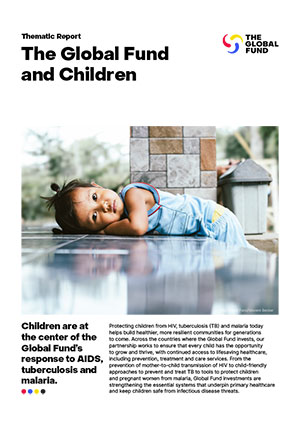
Protecting children from HIV, tuberculosis (TB) and malaria today helps build healthier, more
resilient communities for generations to come. Across the countries where the Global Fund
invests, our partnership works to ensure that every child has the opportunity to grow and
thrive, with continued access to lifesaving healthcare, including prevention, treatment and
care services.
download in English | Français | Italiano


