Digital Health
The Challenge
Investments in digital health maximize the impact of every dollar invested to end AIDS, tuberculosis (TB) and malaria. These investments make entire health systems more robust and efficient by improving data use, clinical decisions, diagnostics, disease surveillance, information sharing, remote monitoring and health worker reach and performance. The digital health tools and initiatives that the Global Fund supports – including digital tools for community health workers, digitizing health data, enhancing supply chains and enabling digital payments – are vital to maximize outcomes in the fight against HIV, TB and malaria and strengthen the health system as a whole.
In low- and middle-income countries that must achieve health outcomes with limited workforce capacity and severely constrained budgets, the rapid advancements in digital and artificial intelligence (AI) enable reimagining health care delivery. Scaling AI to meet the needs of these countries requires a shared commitment to digital infrastructure foundations and thoughtful utilization of AI solutions driven by evidence, aligned with national priorities and focused on equitable access to services.
Our Response
The Global Fund is one of the largest investors in digital health in low- and middle-income countries, investing approximately US$150 million a year in digital tools in over 90 countries. With our partners, we support digital health foundations and transformation to harness the full potential of digital and AI technologies to ensure universal access to quality care. These country-led digital health investments are made through Global Fund grants, alongside catalytic investments that help countries strengthen and scale national digital foundations (such as data systems, interoperability, power and connectivity) across programs. Investments include support for digital health within broader HIV, TB, malaria and health and community systems portfolios.
Over the last two decades, we have invested in health management information systems in over 90 countries. These are critical digital health tools for organizing, analyzing and using health-related data to improve health care delivery and management. As the result of Global Fund investments, most of the countries where we invest now report on local-level health services digitally, streamlining operations, improving patient care and informing programmatic prioritization. We also support countries to integrate and share digital health data from the community to the national level, across disease programs, and across health care services. The exchange of this data is essential to inform patient care, program decision making, and global health security.
Digital innovations and technologies can help ensure that health advancements can reach all affected communities wherever they are, leaving no one behind. We invest in digital health to support community health workers to reach people in the most remote locations.
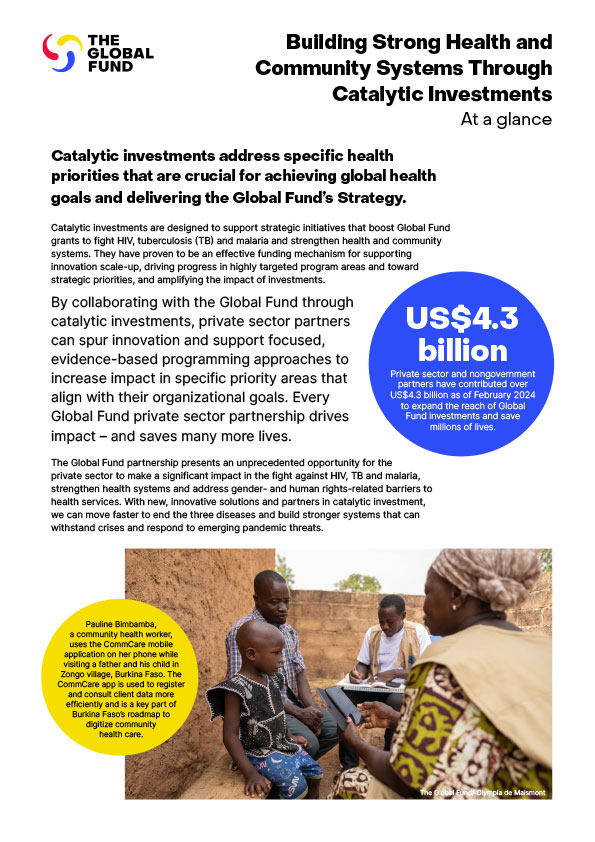
Mobile phone applications designed for community health workers are enabling providers to deliver robust health services to more people – including testing, treatment and referral services. These platforms also improve health data collection, help prevent stockouts of medicines and medical supplies, reduce community health worker workload, and improve efficiency.
Countries scale and sustain proven, high-impact technological advancements, even leapfrogging where possible, by leveraging the Global Fund partnership and mechanisms. For example:
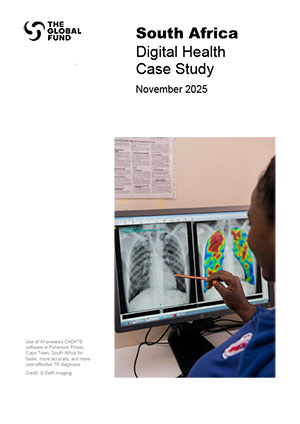
- AI is rapidly improving the ability to detect TB in people and places that conventional health systems often fail to reach. With AI-powered software that analyzes digital chest X-rays, health workers can quickly identify people with TB. In addition to improved reach and coverage, screening for TB in this way is cost-effective, reducing testing costs by up to 61.5% in high-burden countries such as Viet Nam.
- Digital and AI technologies are also increasingly important to protect global health security, including through climate-informed disease surveillance that links weather and environmental data with routine health information systems. In countries like Sierra Leone and Bangladesh, this technology is enabling decision-makers to anticipate and respond faster to risks.
- Interoperability is another area where AI is accelerating progress, including through support for linking electronic health records, laboratory systems and surveillance platforms. In countries such as the Philippines, the time for data extraction across systems is reducing from up to 120 hours to just 2 hours.
The Role of the Private Sector in Expanding Digital Health
The US$25 million Data Science Catalytic Fund (DSCF), a collaboration between the Global Fund and The Rockefeller Foundation, drove data-driven solutions for global health by improving the digital collection and use of community health data in Rwanda, Uganda, Ethiopia and Burkina Faso from 2021 to 2023.
Launched in 2022, and following the foundational investments and key learnings of the DSCF, the US$50 million Digital Health Impact Accelerator (DHIA) is accelerating countries’ digital health transformation in sub-Saharan Africa over the 2024-2026 period. DHIA is scaling power, internet connectivity and digital data system interoperability solutions for integrated, patient-centered care. The DHIA is supported through contributions from partners including Anglo American, the Patrick J. McGovern Foundation, Medtronic LABS, Dimagi, Medic Mobile, Orange and Zenysis.