Results Methodology
The Global Fund is committed to being transparent about the data that we use, the methodologies we adopt, the results we report, and the impact that our partnership achieves. The Global Fund is also eager to show the reasoning behind the approaches we take and any limitations we identify. The 2025 Aid Transparency Index acknowledged the Global Fund’s rigorous systems and commitment to transparency and gave the Global Fund a rating of “Good.”
Notes on Programmatic Results
A Partnership Approach to Results Reporting
This approach to reporting the results and impact of the Global Fund has been developed by the partnership itself, under the leadership of the Board, technical partners and other stakeholders.
The core objective of the Global Fund is to end AIDS, tuberculosis (TB) and malaria by 2030 in the countries where we invest. In developing the Global Fund Strategy 2017-2022 [ download in English | Français ], we conducted extensive consultations in 2015 and 2016 across the partnership on how to best report results and measure the impact of Global Fund investments in national programs. The consensus was that full national results were the best way of measuring progress against the targets set out in the Global Fund Strategy 2017-2022 and toward the ultimate goal of ending the three diseases by 2030. National results should therefore be the starting point for any assessment of the Global Fund’s performance. This approach has been maintained in the Global Fund Strategy 2023-2028 [ download in عربي | English | Español | Français | Português | Русский ]. The Global Fund’s objective is to ensure the success of the country-led national programs that we support alongside other bilateral and multilateral funders, and to complement countries’ own domestic contributions.
For the reasons above, wherever possible[1], the Global Fund reports the full national results of the countries where we invest, rather than reporting solely on the specific projects we fund. This reflects a core principle of the Global Fund: We support national health programs and strategies to achieve national goals. By reporting full national results, the Global Fund can show the impact of the programs we support together with all international and national partners. These results demonstrate where countries are on track to achieve the 2030 targets of ending the three diseases. With this approach, we avoid the pitfall of celebrating the achievements of specific programs supported by the Global Fund when a country as a whole is making insufficient progress or sliding backwards. Furthermore, reporting national results prevents misleading efforts to attribute shares of impact to different actors. Most of the programs and interventions the Global Fund supports involve a mix of domestic resourcing and Global Fund investments, and many involve other external donors. Attributing results to different partners in a common program leads to arbitrary assumptions and ignores the inherently interconnected nature of public health interventions.
An example of this would be a national HIV treatment program where the Global Fund procures the antiretroviral medicines and supports community outreach, PEPFAR funds clinical delivery and laboratory testing, and the government funds the supply chain and underlying infrastructure. In this case, the contribution of each partner is essential for the program to function. Examining scenarios that modify the contribution of a single funder while holding others fixed would likely be misleading or require arbitrary assumptions. Consistent with the collaborative approach in which these programs are funded, the Global Fund believes that where governments, bilateral partners, technical partners and the Global Fund all contribute to the same program, they ought to cite the same results.
Reporting on national results keeps the focus on the big picture and ensures the Global Fund’s interventions are designed to maximize our contribution to achieving each country’s overall goals for the three diseases.
The Global Fund also makes information available on the progress of individual grants in an open data format, accessible via the Global Fund’s Data Service. Data from our portfolio are available through our application programming interface (API), where data sets and reports are available for download. The API is available on the Data Service.
Performance of Global Fund Investments
While the Global Fund focuses our results reporting on national results, we also monitor and report on the performance of specific programs and interventions funded by Global Fund grants. This ensures we are delivering value for money and monitoring the performance of our investments. The Global Fund’s Key Performance Indicators Handbook [ download in English ] for the 2023-2028 Strategy encompasses the reporting of specific key performance indicators (KPIs) to our Board on a range of metrics covering areas attributable to the performance of Global Fund investments, such as the performance of individual programs against agreed grant milestones and targets, absorption rates, fulfilment of co-financing commitments, supply chain metrics, performance of equity/gender/human rights indicators, support in delivering people-centered, high-quality services, progress in pandemic preparedness, and health products market-shaping initiatives.
The Global Fund also provides additional financial and programmatic information through a Data Explorer platform, which includes data and information on resource mobilization, access to funding, financial insights and annual results as well as grants performance to complement our regular reporting on national results and overall KPIs; this enables stakeholders to see how Global Fund investments work alongside the investments of governments and other partners in high-impact countries.
Notes on the Methods to Estimate Lives Saved by Global Fund-supported HIV, TB and Malaria Programs
The methods for reporting on lives saved by Global Fund-supported programs are the same methods currently used by our technical partners (see the details below) and follow the recommendations of an expert group that met in July 2014 to address methodological issues around estimating lives saved. The group included leading experts, technical partners and other global health organizations, including PEPFAR, WHO, UNAIDS, the RBM Partnership to End Malaria and the Stop TB Partnership. The expert group made several recommendations to enhance the Global Fund’s approach to calculating the number of lives saved, and published a detailed meeting report, the Expert Panel on Health Impact of Global Fund Investments Geneva [ download in English ]. Furthermore, the Strategic Review 2015 [ download in English ] commissioned by the independent Technical Evaluation and Reference Group (TERG) and then reviewed and endorsed by the Global Fund Board’s Strategy Committee, concluded that the model used by the Global Fund to assess impact was satisfactory.
To provide ongoing support and guidance, the Global Fund has also established a modeling guidance group consisting of technical partners, including WHO and UNAIDS, modeling experts from leading academic institutions, and other partners. This expert group provides ongoing advice and technical support on the disease transmission models used by the Global Fund, details methodological issues around measurement of impact and efficiency of Global Fund-supported programs, and addresses the limitations of current approaches.
Data Sources
Every year, WHO and UNAIDS publish updated estimates of the burden of HIV, TB and malaria for all past years based on latest available country-level data. They also generate an estimate of lives saved through interventions provided by the national health programs for the three diseases. The figure of lives saved in the Global Fund Results Report corresponds to the portfolio of countries where the Global Fund has been investing since our inception using the latest WHO estimates of lives saved by TB and malaria interventions and the latest UNAIDS and Avenir Health estimates for lives saved by HIV interventions. Due to updates in estimates of burden and underlying models, the latest estimates of lives saved are not comparable with previous years’ estimates. The calculations are described below[2].
Computation Method
The number of lives saved in a given country and year is estimated by subtracting the number of deaths that occurred from the number of deaths that would have occurred in a counterfactual hypothetical scenario where key disease interventions did not take place, as follows:
In the period defined by  , the lives saved is estimated as: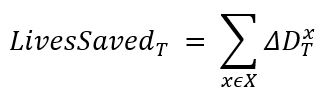
where  represents disease-specific deaths averted and
  represents the different diseases, consisting of:
HIV.
TB among HIV-negative persons.[3]
Malaria.
In each Results Report represents the full calendar years since the inception of the Global Fund.
In each case, for each disease, deaths averted are calculated as the difference in deaths occurring over period under two scenarios, computed as:
Where: is a model for disease
  in country
  , that represents the observed course of the epidemic;
  represents the same model estimated under a counterfactual scenario, representing the absence of effort to combat the disease (the derivations of these models for each disease are described below).
 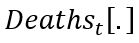 is the number of deaths in year
  in a particular model;
  is the set of countries in the Global Fund portfolio for disease .
 is the fraction of the national-level impact for that disease in that country in that year that is included in Global Fund reporting. Until the end of 2016, the Global Fund only included the total national number of lives saved for a given supported country where a set of criteria in relation to the reported programmatic results were met. The criteria included meeting a minimum threshold of the Global Fund disbursement to the specific programs, either in absolute number or as a percentage of reported public expenditure. From 2017, and following consultation with the Board and key partners, a fully contributory approach is applied, in which the total number of lives saved is counted for a given year and in a given country where the Global Fund invests. Thus, is an indicator function for whether a country’s results are included in a particular year; and
  .
.
Disease-specific Models
A brief overview of models used by the technical partners to estimate lives saved is provided below.
HIV
Details on Spectrum AIM and GOALS models can be found here.
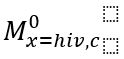 : This model is exactly equal to the respective estimates published by UNAIDS using the AIM model.
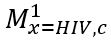 : This model is identical to
 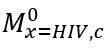 with the following exceptions:
In the period prior to 2017:
The model used is the AIM model.
The coverage of antiretroviral therapy (ART) is assumed to be zero in every year.
In the period since 2017:
The model used is the GOALS model, unless the country did not have a GOALS model, in which case its AIM model is used instead.
The coverage of ART and all other programs is assumed to be zero in the year 2017 and thereafter.
The parameter values relating to “risk behaviors” in the year 2015 are used for every year thereafter.
Tuberculosis
To estimate the number of deaths averted by TB interventions, the actual number of TB deaths is compared with the number of TB deaths that would have occurred in the absence of TB treatment (and without ART provided alongside TB treatment for HIV-positive cases). The latter figure can be estimated conservatively as the number of estimated incident cases multiplied by the relevant estimated case fatality rate (CFR) for untreated TB. CFRs restricted to HIV-negative TB deaths and cases are applied here to avoid double-counting with deaths averted from HIV-positive TB patients. The estimate of the number of deaths averted is conservative, because it does not account for the impact of TB services or availability of ART on the level of TB incidence; it also does not account for the indirect, downstream impact of these interventions on future levels of infections, cases and deaths (details on WHO methods for estimation of burden and deaths averted can be found here).
 : This model is exactly equal to the respective estimates published by the WHO Global Tuberculosis Programme to estimate the global burden of TB disease and lives saved.
 : This model is identical to with the following exception:
The CFR for all cases is equal to that for untreated cases (i.e., representing there being no treatment) with no impact transmission or other disease dynamics.
is only defined in respect of the number of deaths, which is derived thus:
where  is the case-fatality rate for untreated cases. (Note that this value is the same for all countries and over time.)
Malaria
Applying WHO methods, deaths averted are calculated by comparing the current annual estimated burden of malaria with the per capita at risk malaria mortality rates in the year 2000.
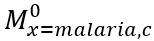 : This model is exactly equal to the respective estimates published by the WHO Global Malaria Programme.
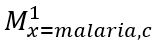 : This model represents the epidemic at the extent estimated to have occurred in the year 2000, which is expressed as maintaining per-capita risk of malaria deaths in the year 2000 over the following years.
is derived thus:
Where  is the ratio of the population at risk in year to that in the year 2000. Thus:
Where  is the number of people who are living in malaria risk areas, which is estimated by WHO.
[1] While national results are primarily used, in certain cases, subnational results were
reported against subnational targets as specified in the Performance Agreements.
[2] The Results Report is typically published in September. At that time, the estimates of
lives saved in the most recent year (publication year minus one) for TB and malaria are considered provisional.
Final estimates are released later in the year by WHO Malaria and TB Departments.
[3] For
TB, the models are limited to TB among HIV-negative persons; outcomes for HIV-positive persons with TB are counted
among the HIV statistics only